
Certification
See if your country
approves our boats
At twelve passengers these boats are straightforward almost everywhere. Going to the full twenty is where your own country's rules decide, and every country answers differently. We read the rules where we could, and published what we found below — including where we found nothing.
Your country
Find your flag
What each country asks of the boat, at twelve passengers and at twenty.
AustriaAt twelve passengers, Easy with paperworkAt twenty passengers, Demanding
Who you deal with
For a boat carrying more than twelve passengers on one of the four federal waterways, the federal ministry BMIMI. For everything else, including every Austrian lake whatever the passenger count, the Landeshauptmann of the region where you are based. There are nine such offices and all of them are published.
At twelve passengers
The boat is treated as a Kleinfahrzeug, a small craft. You need a national Zulassungsurkunde, which is the vessel's own approval document, assessed against a general seaworthiness standard rather than a detailed code. There is a commission survey, and a Konzession, the licence that authorises you to carry passengers commercially. Expect weeks to a few months. Austria does not publish its fees.
At twenty passengers
The boat becomes a Fahrgastschiff, a passenger ship, and loses its small-craft status despite being only 9.13 m. That means a Union certificate, the full ES-TRIN chapter 19, and an independent expert, who is mandatory. The expert may be a chartered marine engineer, a Ziviltechniker für Schiffstechnik, instead of a classification society. Four of them are publicly listed, so this is an expert's fee rather than the cost of entering a class relationship.
Who may drive it
The Schiffsführerpatent, the Austrian boatmaster's licence, for craft up to 20 m covers a boat of this size carrying up to twelve passengers on both the federal waterways and inland waters. It also covers passenger ships under 20 m on inland waters other than the four federal waterways.
Hiring it out without a crew
Austria is the one country where hiring the boat out without a crew is harder than running it yourself. The Upper Austrian lakes regulation bans engined hire boats outright on the Attersee, the Traunsee and the Mondsee, and the commercial exemption that rescues other operations does not extend to hire.
Where the engine matters
Austria restricts engines more than any other country on this list, and the restriction is often about the type of drive rather than the fuel. The Wörthersee admits inboard four-stroke engines only, which means an outboard is not permitted there at any power. The Wolfgangsee bans combustion outboards all year. The Attersee and the Traunsee close to all combustion propulsion from 1 July to 31 August, the peak of the season, and run quotas of thirty and twenty-seven commercial slots. On the Bodensee the recognised list of outboards stops at 59 kW. The Danube has no engine restriction we could find, and it is where the practical Austrian market is. Above twelve passengers on this country's inland waterways, petrol is not an admissible fuel at all, so the twenty-passenger inland configuration would need a different form of propulsion. This does not apply at sea, and it does not apply at twelve passengers.
BelgiumAt twelve passengers, Easy with paperworkAt twenty passengers, Demanding
Who you deal with
At twelve passengers the certificate is federal. Above twelve, competence splits three ways between the federal government, Flanders and Wallonia, and that split is most of the reason the larger configuration becomes difficult.
At twelve passengers
A certificaat van deugdelijkheid, the vessel's certificate of soundness, which costs €488 to issue and €244 to renew, lasts five years, and is valid on both sea and inland water. It is the cheapest five-year certificate on this list.
At twenty passengers
A regional Union certificate, and both regions route the hull inspection to a named classification society. The position at sea we could not establish. The federal flag office at [email protected] is the place to ask.
Who may drive it
We have not established this against an official source, and we would rather say so than guess. Tell us you need it and we will read the rules properly before you commit.
Hiring it out without a crew
We have not established this against an official source, and we would rather say so than guess. Tell us you need it and we will read the rules properly before you commit.
Where the engine matters
We found no Belgian restriction on a petrol outboard. The practical limit in Belgium is geometry rather than regulation: the Bruges canals are too narrow for an enclosed boat of 2.90 m beam, so the coast and the Scheldt are the realistic waters. Above twelve passengers on this country's inland waterways, petrol is not an admissible fuel at all, so the twenty-passenger inland configuration would need a different form of propulsion. This does not apply at sea, and it does not apply at twelve passengers.
BulgariaAt twelve passengers, Not establishedAt twenty passengers, Moderate
Who you deal with
The Maritime Administration Executive Agency, which covers both the sea and the Bulgarian stretch of the Danube. Its Danube offices are at Ruse and Lom.
At twelve passengers
We have not established this against an official source, and we would rather say so than guess. Tell us you need it and we will read the rules properly before you commit.
At twenty passengers
A national passenger survey.
Who may drive it
We have not established this against an official source, and we would rather say so than guess. Tell us you need it and we will read the rules properly before you commit.
Hiring it out without a crew
We have not established this against an official source, and we would rather say so than guess. Tell us you need it and we will read the rules properly before you commit.
Where the engine matters
We found nothing in either direction. The Danube is the water that matters here. Above twelve passengers on this country's inland waterways, petrol is not an admissible fuel at all, so the twenty-passenger inland configuration would need a different form of propulsion. This does not apply at sea, and it does not apply at twelve passengers.
CroatiaAt twelve passengers, EasyAt twenty passengers, Moderate
Who you deal with
The Ministry of the Sea, Transport and Infrastructure sets policy. The Croatian Register of Shipping supervises design and construction, and acts as the recognised organisation above twelve passengers. At twelve, the survey is done by the harbourmaster.
At twelve passengers
You register the boat as a commercial boat, a brodica za gospodarske namjene. The CE design category does real work here: category C maps directly onto navigation area III, twelve nautical miles offshore, by operation of the rule itself rather than by argument. There is no classification society at this count.
At twenty passengers
Croatia has a purpose-built category that reads as though it were drafted for this boat, the open-type passenger ship. It permits navigation areas 7 and 8, within three nautical miles of shore, in daylight between 1 April and 31 October, at under twenty knots. In exchange it drops the subdivision requirements and the full fire matrix that a conventional passenger ship would face.
Who may drive it
At twelve passengers, a category C boat licence as master plus one crew member holding a category B licence. Above twelve the manning rules sit in a separate instrument we did not read, and you should expect a professional certificate of competency.
Hiring it out without a crew
Bareboat charter is a large and mature Croatian industry, and it falls squarely within the Recreational Craft Directive, so the CE marking does the work directly.
Where the engine matters
We found no Croatian prohibition on a petrol outboard. The real constraint is the national parks, Kornati, Krka, Brijuni and Mljet, whose own engine rules we have not read. If you intend to work inside a park, that is the question to settle first.
CyprusAt twelve passengers, Not establishedAt twenty passengers, Not established
Who you deal with
The Shipping Deputy Ministry in Limassol. Its own surveyors appear to inspect coastal and small passenger vessels, which would be good news if it holds.
At twelve passengers
We have not established this against an official source, and we would rather say so than guess. Tell us you need it and we will read the rules properly before you commit.
At twenty passengers
We have not established this against an official source, and we would rather say so than guess. Tell us you need it and we will read the rules properly before you commit.
Who may drive it
We have not established this against an official source, and we would rather say so than guess. Tell us you need it and we will read the rules properly before you commit.
Hiring it out without a crew
We have not established this against an official source, and we would rather say so than guess. Tell us you need it and we will read the rules properly before you commit.
Where the engine matters
We found nothing. Cyprus has no navigable inland waterways, so the inland fuel restriction that affects much of Europe cannot arise here at all. The marine protected areas at Akamas and Cape Greco we did not research.
CzechiaAt twelve passengers, Easy with paperworkAt twenty passengers, Moderate
Who you deal with
The State Navigation Administration, under the 1995 Inland Navigation Act and four implementing decrees.
At twelve passengers
A national small-vessel licence, which takes weeks and costs very little. Czechia is landlocked, so the inland regime is the only regime that applies.
At twenty passengers
A Union inland navigation certificate against ES-TRIN chapter 19, which is then valid on every inland waterway in the European Union.
Who may drive it
We have not established this against an official source, and we would rather say so than guess. Tell us you need it and we will read the rules properly before you commit.
Hiring it out without a crew
We found no separate lighter route for hire without a crew. The general small-vessel decree and the rental provisions would govern it.
Where the engine matters
Off the main rivers a 10 kW power cap and displacement-speed running apply, which closes the Czech reservoirs to this boat entirely. Prague, the Vltava and the Labe are open, and that is where the market is. Above twelve passengers on this country's inland waterways, petrol is not an admissible fuel at all, so the twenty-passenger inland configuration would need a different form of propulsion. This does not apply at sea, and it does not apply at twelve passengers.
DenmarkAt twelve passengers, Easy with paperworkAt twenty passengers, Moderate
Who you deal with
The Danish Maritime Authority. Small commercial vessels are handled by its Centre for Safe Ships, reachable at [email protected] and +45 72 19 60 17.
At twelve passengers
A permit to carry passengers, valid forty-eight months. The engine power alone is enough to trigger a survey and a two-person minimum crew, and you will also need documented safety instruction and insurance.
At twenty passengers
The boat becomes a passenger ship under the 2021 regulation. The Maritime Authority may derogate from the standard requirements on the basis of a formal individual risk assessment demonstrating equivalent safety. That is the realistic path, and it is precisely what our damage stability work was built to support.
Who may drive it
We have not established this against an official source, and we would rather say so than guess. Tell us you need it and we will read the rules properly before you commit.
Hiring it out without a crew
Denmark draws the line cleanly. Hiring the boat out with a skipper is commercial passenger carriage. Hiring it out without one falls under the recreational rules, with equipment requirements set by a 2024 regulation.
Where the engine matters
We found no Danish engine restriction. Denmark sits outside the EU inland directive altogether, so there is no Danish inland regime and the inland fuel restriction that affects much of Europe never arises anywhere in the country.
EstoniaAt twelve passengers, EasyAt twenty passengers, Moderate
Who you deal with
The Estonian Transport Administration handles ships, small craft, registration, survey, certificates and skipper tickets. A classification society only becomes involved at 500 gross tonnes or more, or if the owner asks for one. Restrictions on individual inland waters come from the Environmental Board and the municipality.
At twelve passengers
Paid leisure trips run on the small-craft route. You register the boat, hold a small-craft skipper's certificate, and keep the technical inspection current, which means every three years while the boat is under ten years old and every two years after that. A timetabled service falls outside that route and the boat becomes a ship, but even that stays light. Below 12 m length overall no seaworthiness certificate is issued at all, only an annual inspection act.
At twenty passengers
The boat becomes a passenger ship, which means a passenger certificate and an annual full survey against the national ship safety requirements. No classification society is involved.
Who may drive it
A small-craft skipper's certificate, with the holder at least eighteen. Beyond five nautical miles you need one certificated skipper per liferaft, and a restricted radiotelephone operator's certificate.
Hiring it out without a crew
This is the lightest route in Estonia. A craft hired out for leisure trips stays within the small-craft definition, so you need registration, the periodic inspection, small-craft equipment and a hirer who holds the certificate. There is no operator licence and no survey beyond that, and it is the configuration the Recreational Craft Directive covers directly.
Where the engine matters
Propulsion is unrestricted on the navigable inland waters, which are Peipsi, Võrtsjärv, the Emajõgi and the Narva. The general combustion-engine restriction expressly excludes navigable waters. Estonia is one of only a handful of countries in Europe with no engine constraint at all.
FinlandAt twelve passengers, EasyAt twenty passengers, Moderate
Who you deal with
Traficom, the Finnish Transport and Communications Agency, under the Ship Safety Act as amended in December 2019.
At twelve passengers
If you run crewed charter, the boat is a vuokravene, a hire boat, and the inspection and special equipment requirements for that category were abolished on 1 June 2020. There is no survey requirement at all. The CE design category maps onto domestic traffic areas I and II. A scheduled service takes a different route, requiring a conformity assessment by a notified body, a Traficom certificate and an initial survey.
At twenty passengers
A domestic passenger ship survey. Self-inspection is not available to passenger ships, so the recurring burden is four surveys and two bottom inspections every five years. The Traficom rule explicitly covers vessels under 24 m and hulls that are not steel.
Who may drive it
A charter boat skipper's certificate on the charter route. On the scheduled-service route the boat is treated as a cargo ship for manning and competency purposes.
Hiring it out without a crew
This is the lightest option of all. A boat hired out without a crew is an ordinary recreational craft and the CE regime governs it. No commercial certificate, no survey, and no professional skipper's licence.
Where the engine matters
We found no national engine restriction in Finland.
FranceAt twelve passengers, Easy with paperworkAt twenty passengers, Moderate
Who you deal with
At sea, the Directorate of Maritime Affairs through the local ship safety centres. Inland, the transport directorate, with the case handled by the navigation unit at département level.
At twelve passengers
At sea, a Division 241 navigation permit, with no structural inspection required below 12 m. Inland, a boat certificate, where the visiting commission may be waived if you are working in a port area. Your navigation category, from 1 to 5, sets how far from shelter you may operate.
At twenty passengers
French rules include a dedicated section for passenger ships under 24 m, and it carries a named exemption for uninsulated aluminium hulls built after December 2017. That is the single most favourable clause of its kind on this list. Inland, it is a Union certificate against ES-TRIN chapter 19.
Who may drive it
At sea, commercial passenger carriage needs a professional certificate rather than a recreational one. The relevant qualification at this size covers commercial vessels under 200 gross tonnes within twenty nautical miles of the coast, but note that it carries a 250 kW propulsion ceiling.
Hiring it out without a crew
This is the lightest route in France. Hiring the boat out without a crew keeps it a recreational craft under the recreational division rather than the commercial ones, and inland a pleasure boat under 20 m needs no Union certificate at all.
Where the engine matters
We found no general French engine restriction. The 250 kW ceiling on the professional skipper's ticket is a crewing constraint rather than an engine one, but in practice it bites the same way. Above twelve passengers on this country's inland waterways, petrol is not an admissible fuel at all, so the twenty-passenger inland configuration would need a different form of propulsion. This does not apply at sea, and it does not apply at twelve passengers.
Germany★At twelve passengers, Easy with paperworkAt twenty passengers, Easy with paperwork
Who you deal with
Four bodies, and which one you meet depends on the water. The waterways and shipping directorate handles all inland examinations. The maritime employers' liability body handles everything seagoing.
At twelve passengers
Germany has a national vessel category, the Fahrgastboot, that sits below a full passenger ship and is built directly on top of recreational design categories. On zone 3 waterways it requires at least CE design category C, which this boat already holds. The category is the qualifying criterion itself rather than supporting evidence. An examination commission then checks the boat against a defined list.
At twenty passengers
The same category carries up to thirty-five passengers on the waterways listed in Annex IX, which is essentially the whole Berlin and Brandenburg network, the German Mosel including Trier, the upper Elbe from the Czech border to Kreinitz including Dresden, the Saale, the Müritz and the Mecklenburg lakes. The additional work is a defibrillator and a capacity and stability recalculation. This is the strongest position anywhere in Europe above twelve passengers.
Who may drive it
The manning rules require a skipper plus a deckhand, with a single-handed derogation in zones 3 and 4. Above twelve passengers you also need a Union certificate of competence for passenger navigation.
Hiring it out without a crew
This is the lightest route in Germany and it is already open. The EU Declaration of Conformity is named in the hire regulation as statutory proof of fitness for commercial hire, valid ten years. The 2018 declaration already qualifies, and it runs until 2028.
Where the engine matters
The Bodensee is closed to this boat: every newly registered engine needs a specific exhaust approval and the recognised list stops at 59 kW. Elsewhere in Germany we found no restriction. Note also that Fahrgastboote are not permitted on the Rhine at all, and that the seagoing commercial certificate expressly does not cover harbour tours or water-taxi work.
GreeceAt twelve passengers, ModerateAt twenty passengers, Moderate
Who you deal with
The Ministry of Maritime Affairs sets policy and holds the flag. Inspection is done by the merchant ship inspection branch or an authorised organisation. The local port authority handles declarations and your area of operation.
At twelve passengers
The boat operates as a professional tourist day boat under the 2014 shipping law, with a certificate and a port authority declaration. The category runs to forty-nine passengers, so there is no step-up at twelve at all.
At twenty passengers
The same regime. Twenty passengers sits comfortably inside the forty-nine-passenger ceiling, and we found no construction requirement that changes at twelve, which is encouraging if you are planning the larger configuration.
Who may drive it
We have not established this against an official source, and we would rather say so than guess. Tell us you need it and we will read the rules properly before you commit.
Hiring it out without a crew
Greece has the most permissive provision of its kind on this list. A professional recreational vessel up to 24 m may be chartered out with no master and no crew at all. That places it squarely inside the Recreational Craft Directive, so the CE marking does the whole job and nothing national is required.
Where the engine matters
We found no Greek engine prohibition. The live constraints are the marine protected areas.
HungaryAt twelve passengers, Not establishedAt twenty passengers, Moderate
Who you deal with
The Budapest government office is the first-instance authority you actually deal with. Policy sits with the shipping authority department of the transport ministry.
At twelve passengers
Two sources disagree here and we will not pick one for you. The rule accepts conformity verified by a conformity assessment body accredited in the European Economic Area, and IMCI is exactly that, which on its face lets the craft skip the initial survey. Against that, we tried this ourselves. In autumn 2022 we commissioned a certified Hungarian naval architect for a Budapest operation and the submission ran to twenty-five documents, assessed at twelve passengers and two crew, including intact stability, damage stability, a capacity calculation and local strength. Until the two are reconciled we are calling Hungary not established at twelve rather than easy.
At twenty passengers
A Union inland navigation certificate, valid on every inland waterway in the European Union, against the full ES-TRIN chapter 19. Much of the stability work already exists. Fire protection, escape routes and life-saving arrangements do not, and a fully enclosed nine metre deck will probably need a layout change.
Who may drive it
A recreational ticket is not enough in Hungary. The commercial small-craft qualification requires approved training plus fourteen months of service, and above twelve passengers there is a separate endorsed category.
Hiring it out without a crew
Not obviously lighter. A hirer navigating for pleasure needs no licence, but the boat still needs registration and a valid certificate, and the exemption is drafted around the person navigating rather than around the rental business.
Where the engine matters
Combustion engines are banned on Balaton, Velence, Fertő, the Ráckevei-Duna and Tisza-tó. Balaton is reachable only through a discretionary two-year permit with environmental consent, and it is classified as the more demanding zone 2 rather than zone 3. Above twelve passengers on this country's inland waterways, petrol is not an admissible fuel at all, so the twenty-passenger inland configuration would need a different form of propulsion. This does not apply at sea, and it does not apply at twelve passengers.
IcelandAt twelve passengers, Easy with paperworkAt twenty passengers, Moderate
Who you deal with
The Icelandic Transport Authority, under the 2021 Ship Act and the 2023 inspection regulation.
At twelve passengers
A seaworthiness certificate plus a passenger permit, on a defined survey cycle. On the published evidence this takes weeks to a few months and low four figures, with no change to the boat expected, though it is materially more work than Norway, Sweden or a Finnish charter.
At twenty passengers
A national passenger survey.
Who may drive it
Iceland requires professional certificates for commercial passenger carriage. You may encounter a claim that no licence is needed under 15 m. That is about recreational use and must not be relied on here.
Hiring it out without a crew
We have not established this against an official source, and we would rather say so than guess. Tell us you need it and we will read the rules properly before you commit.
Where the engine matters
We found no Icelandic engine restriction.
IrelandAt twelve passengers, Easy with paperworkAt twenty passengers, Demanding
Who you deal with
The Marine Survey Office within the Department of Transport in Dublin. Inland navigations are administered by Waterways Ireland.
At twelve passengers
A Passenger Boat Licence in classes P1 to P6, surveyed by a departmental marine surveyor. It costs €144 including the survey and lasts two years, which makes it the cheapest passenger-carrying route on this list. No stability book is demanded beyond what the surveyor asks for, no change to the boat, and no classification society.
At twenty passengers
A Passenger Ship Certificate, an annual survey, and a certificate of survey from two or more approved surveyors. The annual interval alone is materially more onerous than the British five-year certificate.
Who may drive it
A valid certificate with a commercial endorsement. The requirements above twelve passengers we could not establish.
Hiring it out without a crew
Not established, though there is strong circumstantial evidence that a lighter route exists: Ireland has a large Shannon hire-cruiser industry whose boats carry no passenger boat licence, and two 2002 statutory instruments set out the exemptions.
Where the engine matters
We found no Irish engine restriction.
ItalyAt twelve passengers, EasyAt twenty passengers, Demanding
Who you deal with
The port authorities at sea. Inland, the civil motorisation offices at Milan, Brescia, Venice and Rome, inspecting through territorial inland navigation commissions.
At twelve passengers
At 9.13 m the boat is a natante da diporto. Italy's recreational classes break at ten metres, not at twenty-four, and they are measured to the same ISO standard as our Declaration of Conformity. That means no registration and no navigation licence, and the boat may be chartered up to twelve people on its CE marking alone.
At twenty passengers
Inland is the better half. Every Italian waterway is classified as zone 4, the mildest ES-TRIN zone, and a Union certificate is issued through the civil motorisation office. At sea there is no route at all below twenty-four metres: the charter provision caps at twelve and everything above it is redirected to a decree that starts at 24 m.
Who may drive it
A boating licence is required for the user of a commercially used craft, and in any case for an engine over 40.8 kW. Above twelve passengers on inland waters a boatmaster's certificate would apply.
Hiring it out without a crew
Covered by the CE marking on the natante route.
Where the engine matters
The northern Trentino stretch of Lake Garda prohibits motor navigation outright, so the boat cannot operate there at all. Elsewhere on Garda the limit is twenty knots by day and five by night, with motor vessels excluded within 300 m of the shore. On Como, Maggiore and Iseo, only electric motors under 3 HP are allowed within 50 m of the shore. Those exclusions matter for a sightseeing boat, whose value lies precisely in running close in. Above twelve passengers on this country's inland waterways, petrol is not an admissible fuel at all, so the twenty-passenger inland configuration would need a different form of propulsion. This does not apply at sea, and it does not apply at twelve passengers.
LatviaAt twelve passengers, Easy with paperworkAt twenty passengers, Not established
Who you deal with
The Maritime Administration of Latvia holds the flag and technical supervision. Small craft are registered with the Road Traffic Safety Directorate, in the national vehicle register rather than a ship register.
At twelve passengers
CE marking is the precondition for registering the boat at all. Commercial use then runs on a single endorsement on the registration certificate, and nothing we read requires a survey, a classification society or a stability book. On paper this is the lightest paperwork in the Baltics.
At twenty passengers
We have not established this against an official source, and we would rather say so than guess. Tell us you need it and we will read the rules properly before you commit.
Who may drive it
The regulation that set the qualification grades has been repealed and we could not identify its replacement. The Road Traffic Safety Directorate examines and issues small-craft operator certificates.
Hiring it out without a crew
Not separately regulated in what we read. Whether hiring the boat out triggers the commercial endorsement is unresolved, and the wording on its face appears to catch it, so assume it does until the administration says otherwise.
Where the engine matters
Engine rules in Latvia are municipal and set water by water. We found no national rule.
LithuaniaAt twelve passengers, EasyAt twenty passengers, Moderate
Who you deal with
The Transport Safety Administration handles inland navigation safety and certificates. Technical inspections are carried out by private bodies attested by it and accredited as inspection bodies to the relevant ISO standard.
At twelve passengers
You register the boat and then have an annual technical inspection, with the CE file checked at registration. The code demands no classification society and no stability book. Lithuania also expressly permits a small vessel to run a scheduled service, which is the opposite of the Estonian position and useful if you are planning a timetabled link.
At twenty passengers
The boat becomes a passenger ship, with a certificate valid ten years and confirmed at least annually. Separately, the administration will issue a Union inland navigation certificate even though the boat sits below the directive's own thresholds. That one is valid five years and good on all EU inland waterways.
Who may drive it
Valid qualification documents are required for every type of carriage, and where no crew is required the boatmaster must ensure safe carriage. The specific certificate grades are not named in the code.
Hiring it out without a crew
The code separates hire with operating services from bare hire, and bareboat hire of a recreational craft keeps it recreational. We did not trace the route separately.
Where the engine matters
The binding constraint in Lithuania is the protected areas of the Nemunas delta rather than any national engine rule. Above twelve passengers on this country's inland waterways, petrol is not an admissible fuel at all, so the twenty-passenger inland configuration would need a different form of propulsion. This does not apply at sea, and it does not apply at twelve passengers.
LuxembourgAt twelve passengers, Not establishedAt twenty passengers, Moderate
Who you deal with
The navigation service under the ministry of mobility and public works, under the 2019 technical law.
At twelve passengers
We have not established this against an official source, and we would rather say so than guess. Tell us you need it and we will read the rules properly before you commit.
At twenty passengers
Luxembourg does issue Union inland navigation certificates.
Who may drive it
We have not established this against an official source, and we would rather say so than guess. Tell us you need it and we will read the rules properly before you commit.
Hiring it out without a crew
We have not established this against an official source, and we would rather say so than guess. Tell us you need it and we will read the rules properly before you commit.
Where the engine matters
Above twelve passengers on this country's inland waterways, petrol is not an admissible fuel at all, so the twenty-passenger inland configuration would need a different form of propulsion. This does not apply at sea, and it does not apply at twelve passengers.
MaltaAt twelve passengers, Easy with paperworkAt twenty passengers, Not established
Who you deal with
Transport Malta's ports and yachting directorate for local waters. The survey is carried out by a government appointed surveyor or a recognised organisation.
At twelve passengers
An operator licence plus a certificate for the vessel itself, under the Code of Practice for the Safety of Commercial Vessels, whose fifteenth edition came into force on 1 October 2025. The structure is administratively straightforward and nothing we found implies a change to the boat.
At twenty passengers
We have not established this against an official source, and we would rather say so than guess. Tell us you need it and we will read the rules properly before you commit.
Who may drive it
We have not established this against an official source, and we would rather say so than guess. Tell us you need it and we will read the rules properly before you commit.
Hiring it out without a crew
We have not established this against an official source, and we would rather say so than guess. Tell us you need it and we will read the rules properly before you commit.
Where the engine matters
We found no ban, power cap, emission or noise rule for a petrol outboard in Maltese waters, though we were not able to read the rules either way. Malta has no lakes and no rivers, so the inland fuel restriction that affects much of Europe cannot arise here. The marine protected areas around Comino, the Blue Lagoon and Filfla we did not research.
NetherlandsAt twelve passengers, Easy with paperworkAt twenty passengers, Moderate
Who you deal with
The Human Environment and Transport Inspectorate. Municipalities are a second and independent gate for working in a city centre, and in Amsterdam that gate is currently the binding one.
At twelve passengers
On inland water this is light: no ship certificate at all, just a small-craft boating licence, a marine radio and any municipal licence. At sea, paying passengers make the boat a merchant vessel, which triggers measurement, registration, a sea letter, a crew certificate and an engine emissions certificate above 130 kW.
At twenty passengers
Inland, a ship certificate against ES-TRIN chapter 19, which on paper is the clearest inland route in Europe. At sea you need a recognised organisation and a passenger liability certificate.
Who may drive it
A small-craft boating licence inland. At sea, a crew certificate.
Hiring it out without a crew
Hiring the boat out without a crew keeps it under its CE marking.
Where the engine matters
Passenger vessels on Amsterdam inland water have had to be emission-free since 1 January 2025, and four other places already require the same. A petrol boat cannot be licensed in Amsterdam. Above twelve passengers on this country's inland waterways, petrol is not an admissible fuel at all, so the twenty-passenger inland configuration would need a different form of propulsion. This does not apply at sea, and it does not apply at twelve passengers.
NorwayAt twelve passengers, EasyAt twenty passengers, Moderate
Who you deal with
The Norwegian Maritime Authority, under a 2020 regulation for vessels under 24 m carrying twelve or fewer passengers, most recently amended with effect from 1 January 2026.
At twelve passengers
There is no approval, no certificate and no survey. You register the business with the Maritime Authority before you start and self-declare compliance. This is the lightest market entry we found anywhere in Europe.
At twenty passengers
A passenger certificate from the Maritime Authority, with different construction, equipment and crew rules.
Who may drive it
At twelve passengers or fewer in commercial operation a recreational skipper's certificate may be used, which the Maritime Authority documents explicitly. That is a genuinely low barrier and it materially lowers a small operator's cost of entry. A higher grade is required outside the large coastal navigation area.
Hiring it out without a crew
Hiring without a crew is recreational use governed by the CE marking, and the commercial regulation applies to vessels carrying passengers, so bareboat hire falls outside it.
Where the engine matters
The five World Heritage fjords, Geiranger, Sunnylvsfjord, Tafjord, Nærøyfjord and Aurlandsfjord, went zero-emission on 1 January 2026. That lands on the most valuable fjord tourism water in the country.
PolandAt twelve passengers, Easy with paperworkAt twenty passengers, Moderate
Who you deal with
The Director of the Inland Navigation Office is the inspection body. There are three, at Bydgoszcz, Szczecin and Wrocław, each acting through a technical inspection commission.
At twelve passengers
A simplified certificate of navigational capability, which is a dedicated light instrument written specifically for vessels under 20 m carrying a maximum of twelve passengers.
At twenty passengers
A Union inland navigation certificate, issued through the technical inspection commission.
Who may drive it
We have not established this against an official source, and we would rather say so than guess. Tell us you need it and we will read the rules properly before you commit.
Hiring it out without a crew
We have not established this against an official source, and we would rather say so than guess. Tell us you need it and we will read the rules properly before you commit.
Where the engine matters
We found no national Polish engine restriction. Above twelve passengers on this country's inland waterways, petrol is not an admissible fuel at all, so the twenty-passenger inland configuration would need a different form of propulsion. This does not apply at sea, and it does not apply at twelve passengers.
Portugal★At twelve passengers, EasyAt twenty passengers, Easy with paperwork
Who you deal with
The natural resources and maritime services directorate handles the flag, technical matters, registration and certification. The national maritime authority and the local captaincies handle surveys and crewing. Operators register with Turismo de Portugal.
At twelve passengers
This is the easiest route on this list. Recreational craft are named outright as an admitted vessel type for maritime-tourist activity, and the EU Declaration of Conformity itself satisfies the survey requirement. What remains is an annual inspection, a tourism plate, and the operator's own licence.
At twenty passengers
If the reading of the crewing provision holds, Portugal stays a light route above twelve as well, which would make it the easiest twenty-passenger market in Europe. If it does not, it becomes a national survey.
Who may drive it
For tourist operation up to twelve people excluding crew, a recreational navigator's certificate appropriate to the vessel type and navigation area is enough. That is a notably light qualification bar for commercial passenger work.
Hiring it out without a crew
Expressly lighter. Recreational craft hired out without a crew observe only the recreational boating regime, not the maritime-tourist regulation.
Where the engine matters
We found no ban and no power cap anywhere in Portugal, which makes it the cleanest propulsion answer on this list. Two caveats we could not verify. The Ria Formosa is a natural park whose own rules will set access and possibly engine conditions, and the Douro is administered by a port authority that conditions the vessel's certificate on an adequate base berth and on AIS.
RomaniaAt twelve passengers, Easy with paperworkAt twenty passengers, Moderate
Who you deal with
The Romanian Naval Authority, under the transport ministry, acting through port captaincies and technical inspectorates.
At twelve passengers
A national small-vessel licence, and the lightest route in its region.
At twenty passengers
A Union inland navigation certificate against ES-TRIN chapter 19.
Who may drive it
We have not established this against an official source, and we would rather say so than guess. Tell us you need it and we will read the rules properly before you commit.
Hiring it out without a crew
We have not established this against an official source, and we would rather say so than guess. Tell us you need it and we will read the rules properly before you commit.
Where the engine matters
The Danube Delta caps engines at ten, forty or one hundred horsepower depending on the channel. At roughly three hundred horsepower the boat is well over the limit even at the most permissive point, which excludes it as currently engined from exactly the shallow protected water it was designed for. Above twelve passengers on this country's inland waterways, petrol is not an admissible fuel at all, so the twenty-passenger inland configuration would need a different form of propulsion. This does not apply at sea, and it does not apply at twelve passengers.
SlovakiaAt twelve passengers, Easy with paperworkAt twenty passengers, Demanding
Who you deal with
The Transport Authority's inland navigation division in Bratislava, with offices at Komárno, Žilina and Košice.
At twelve passengers
A national small-vessel licence. An Estonian skipper's licence is accepted directly, with no recognition procedure. One thing to plan for that nobody mentions until you are committed: the boat goes onto the Slovak Transport Registry, and it has to come off your own national register first, because a vessel cannot sit in two at once. We have done this ourselves at twelve passengers and it was straightforward.
At twenty passengers
Slovak law makes classification by a recognised classification society mandatory for vessels up to 20 m intended to carry more than twelve passengers. Of all thirty-one countries in this document, Slovakia is the only one where that is genuinely unavoidable.
Who may drive it
An Estonian ticket is accepted directly, which is unusual across Europe and worth knowing.
Hiring it out without a crew
Slovak law contains rental relief provisions.
Where the engine matters
We found no restriction on the Danube, which makes Slovakia one of the clean propulsion answers. Above twelve passengers on this country's inland waterways, petrol is not an admissible fuel at all, so the twenty-passenger inland configuration would need a different form of propulsion. This does not apply at sea, and it does not apply at twelve passengers.
Slovenia★At twelve passengers, Easy with paperworkAt twenty passengers, Easy with paperwork
Who you deal with
The Slovenian Maritime Administration in Koper, with branches at Izola and Piran. Inland boat registration goes to the local administrative unit instead, and the navigation regime for each individual water is set by the municipality.
At twelve passengers
You register the boat, the Maritime Administration itself carries out the initial survey, and you then hold a navigation permit with an annual survey and one qualified crew member. Your Declaration of Conformity removes the verification of the boat's properties altogether, so only the equipment is checked. No change to the boat and no classification society.
At twenty passengers
Slovenia has no step-up at twelve passengers below 24 m. The same category of boat carries up to fifty passengers on the same authority, the same surveyor, the same permit, the same four-mile band and the same crew qualification as at twelve. The threshold that decides things in Slovenia is twelve metres rather than twelve passengers. Above 12 m it would be a classification society matter.
Who may drive it
One qualified crew member covers this category of boat up to fifty passengers. Above fifty it becomes a master plus a watch officer.
Hiring it out without a crew
Genuinely lighter. Hire falls into a different commercial purpose, so the survey interval becomes two years rather than annual, and the crew requirement applies only to hire boats over 12 m. At 9.13 m no qualified crew member is required at all.
Where the engine matters
Every Slovenian inland water we examined is closed to this boat on the engine rather than on paperwork. Bled and Bohinj ban motorised craft outright, and the Ljubljanica and the Sava reservoirs permit commercial passenger transport on electric propulsion only, at five to ten kilometres an hour.
SpainAt twelve passengers, Easy with paperworkAt twenty passengers, Moderate
Who you deal with
The Directorate General of the Merchant Marine and the local maritime captaincies. Inland waters are authorised basin by basin by the river basin authorities, with the autonomous community adding its own charter licensing layer on top.
At twelve passengers
Registration in the commercial list and a certificate of navigability, with periodic inspections and a regional charter declaration. The CE design category does real work: category C maps onto navigation zones 4 to 7, twelve miles offshore, by operation of the rule itself.
At twenty passengers
A national regime, since vessels under 24 m were removed from the passenger ship decree in December 2019. We were not able to identify the instrument that now governs it.
Who may drive it
Recreational qualifications are governed by a 2014 decree, though we did not verify which title covers which zone. Commercial passenger carriage would require a professional certificate.
Hiring it out without a crew
We have not established this against an official source, and we would rather say so than guess. Tell us you need it and we will read the rules properly before you commit.
Where the engine matters
We found no general restriction at sea. Inland is another matter: explosion engines are prohibited within fifty metres of reservoir shores, some reservoirs prohibit all navigation and others prohibit motor navigation specifically. A complete list is only obtainable reservoir by reservoir, so do not plan a Spanish inland operation before the specific water body has been checked.
SwedenAt twelve passengers, EasyAt twenty passengers, Moderate
Who you deal with
The Swedish Transport Agency, under the Ship Safety Act and the 2017 national shipping regulations.
At twelve passengers
No certificate is required under 15 m. You report the operation, document your limitations, run your own safety management and put a class VIII skipper aboard. Nothing falls on the boat at all.
At twenty passengers
A passenger ship certificate. There is a dedicated track for vessels between five and fifteen metres: you notify the agency, you meet, and the requirements are set case by case. That cuts both ways, because there is no published standard to work towards in advance.
Who may drive it
A class VIII deck officer's certificate or an equivalent skipper's examination, plus a valid seafarer's medical certificate. Above twelve passengers you also need a practical handling test with an agency ship inspector, recorded in the vessel's safe manning decision.
Hiring it out without a crew
Not a distinct lighter route in Sweden. A vessel hired out without a crew is a leisure craft, which the regulations exclude at 24 m or less, so the CE marking governs. That is the ordinary recreational position rather than a special commercial regime.
Where the engine matters
We found no national Swedish engine restriction.
SwitzerlandAt twelve passengers, Easy with paperworkAt twenty passengers, Moderate
Who you deal with
The Federal Office of Transport sets the framework, but the office you actually deal with is one of the twenty-six cantonal navigation offices.
At twelve passengers
A short and clearly defined national code, one article of the general regulation plus thirteen articles of the passenger transport regulation. There is no Swiss stability book, no plan approval and no professional skipper requirement at this count. The real work is physical. A collision bulkhead, a fire-resistant interior with detection, escape routes, backup steering, one metre guardrails and a special-use registration. Expect weeks and a low four-figure sum in francs, mostly documentation rather than fees.
At twenty passengers
A plan approval before building, with a safety report, and the authority sets the passenger number itself. You will need intact and damage stability, residual freeboard, subdivision, escape routes, fire detection and fixed firefighting, life-saving equipment for the full complement, periodic inspections and a logbook. No classification society is mandatory, but the authority may require an independent expert, so budget for one.
Who may drive it
A licence is required above 6 kW, so always in this case. Category A at twelve passengers, and the professional category B for passenger vessels.
Hiring it out without a crew
A hire boat is a distinct registration category in Switzerland. In an unmanned charter the hirer becomes the skipper, so the commercial passenger transport rules are not triggered.
Where the engine matters
Federally, petrol is easier than diesel. The regulation names an RCD declaration as exactly what is required for a spark-ignition engine in commercial transport, which is the opposite of the position on EU inland waterways. The constraints are cantonal. The Sihlsee, Wägitalersee and Lauerzersee cap at 6 kW, the Sempachersee at 70 kW with a four-hundred-boat quota, and the Bodensee at 59 kW.
United KingdomAt twelve passengers, Easy with paperworkAt twenty passengers, Moderate
Who you deal with
The Maritime and Coastguard Agency, Ship Standards, in Southampton. Day-to-day certification is delegated to certifying authorities listed in the Code.
At twelve passengers
The Sport or Pleasure Vessel Code, in force since 12 December 2025. It does something unusual and very much in this boat's favour. It makes the recreational design category itself the qualifying criterion for an area category of operation, so category C admits the boat to area categories 4, 5 and 6 outright. Better still, the Code names Module A1, the precise conformity route this boat was assessed under, as an accepted basis for assigning that area category from the Declaration of Conformity, in place of the Code's own stability testing.
At twenty passengers
The Small Seagoing Passenger Ship Code. The design category does nothing here, but the Code's stability requirements for simple ships are a far easier gate than the inland equivalent, and our existing stability work clears them with room to spare. This is the best-documented twenty-passenger route in Europe.
Who may drive it
Above twelve passengers, a Boat Master's Licence is a suitable qualification. At twelve or fewer under the newer Code we could not verify the requirement, as the Code cross-refers to the 2022 training and certification regulations.
Hiring it out without a crew
Not resolved. The Code excludes pleasure vessels, and the CE regime covers craft placed on the market for recreational use including bareboat hire, but whether a bareboat-chartered boat escapes the Code in British practice turns on how the pleasure vessel definition applies to a paying hirer.
Where the engine matters
Internal combustion is prohibited on roughly twenty Lake District lakes under bye-laws dating from 1971.
Beyond Europe
Market research rather than statute, and not confirmed with any of these authorities. The marks mean the same as above. Treat a row here as a strong lead and ask us before you commit to anything.
AustraliaAt twelve passengers, Easy with paperworkAt twenty passengers, Moderate
Who you deal with
The Australian Maritime Safety Authority, under the National Standard for Commercial Vessels.
At twelve passengers
Survey obligations are lighter for a boat under twelve metres working sheltered water, and a foreign-built hull is accepted into survey.
At twenty passengers
Thirteen passengers makes it a Class 1 passenger vessel, which needs a Certificate of Survey. The standard is published and well documented.
Who may drive it
We have not established this against an official source, and we would rather say so than guess. Tell us you need it and we will read the rules properly before you commit.
Hiring it out without a crew
We have not established this against an official source, and we would rather say so than guess. Tell us you need it and we will read the rules properly before you commit.
Where the engine matters
We have not established this against an official source, and we would rather say so than guess. Tell us you need it and we will read the rules properly before you commit.
CanadaAt twelve passengers, Easy with paperworkAt twenty passengers, Moderate
Who you deal with
Transport Canada Marine Safety. The same body registers the boat and inspects anything carrying more than twelve passengers.
At twelve passengers
Registration and the ordinary small commercial vessel requirements. Canada does not restrict foreign-built boats. The Coasting Trade Act turns on foreign registration and unpaid duty rather than on where the hull was welded, and under the EU trade agreement the duty is zero, so the condition is met at nil cost.
At twenty passengers
Above twelve passengers Transport Canada inspects and certifies the vessel whatever its tonnage, then re-inspects to keep the certificate current. Construction is judged against TP 1332, the small vessel construction standard, whose own scope covers boats imported into Canada.
Who may drive it
We have not established this against an official source, and we would rather say so than guess. Tell us you need it and we will read the rules properly before you commit.
Hiring it out without a crew
We have not established this against an official source, and we would rather say so than guess. Tell us you need it and we will read the rules properly before you commit.
Where the engine matters
We have not established this against an official source, and we would rather say so than guess. Tell us you need it and we will read the rules properly before you commit.
MontenegroAt twelve passengers, Easy with paperworkAt twenty passengers, Not established
Who you deal with
The Administration for Maritime Safety and Port Management.
At twelve passengers
Registration and technical supervision by the Administration.
At twenty passengers
Montenegrin law defines a ship as exceeding both twelve metres and fifteen gross tons, and a passenger ship has to be a ship first. At 9.13 m the LR9 is neither, so the passenger ship rules do not reach it at any passenger count. That is the same shape as Slovenia and Italy, where the length threshold sits above the boat and the passenger-count cliff never engages.
Who may drive it
We have not established this against an official source, and we would rather say so than guess. Tell us you need it and we will read the rules properly before you commit.
Hiring it out without a crew
We have not established this against an official source, and we would rather say so than guess. Tell us you need it and we will read the rules properly before you commit.
Where the engine matters
We have not established this against an official source, and we would rather say so than guess. Tell us you need it and we will read the rules properly before you commit.
New ZealandAt twelve passengers, Easy with paperworkAt twenty passengers, Moderate
Who you deal with
Maritime New Zealand, through the Maritime Operator Safety System.
At twelve passengers
The system is built around the operator rather than the boat. You hold an approved safety system, and each vessel carries a survey plan approved by a recognised surveyor.
At twenty passengers
The same system. The survey plan carries the passenger number.
Who may drive it
We have not established this against an official source, and we would rather say so than guess. Tell us you need it and we will read the rules properly before you commit.
Hiring it out without a crew
We have not established this against an official source, and we would rather say so than guess. Tell us you need it and we will read the rules properly before you commit.
Where the engine matters
We have not established this against an official source, and we would rather say so than guess. Tell us you need it and we will read the rules properly before you commit.
TurkeyAt twelve passengers, Not establishedAt twenty passengers, Not established
Who you deal with
The transport ministry. Recreational craft sit under a national regulation that transposes the EU directive almost word for word.
At twelve passengers
One half of this is settled and the other is not. The Recreational Craft Directive applies in Turkey much as it does inside the Union, transposed in a regulation in force since 5 May 2017, and the customs union brings CE marking, notified bodies and market surveillance with it, so the boat's own conformity papers are recognised. What nobody has read is the Turkish commercial passenger regime that sits on top of that, which is why this says not established rather than easy.
At twenty passengers
Not read. The commercial passenger regime sits in Turkish maritime law.
Who may drive it
We have not established this against an official source, and we would rather say so than guess. Tell us you need it and we will read the rules properly before you commit.
Hiring it out without a crew
We have not established this against an official source, and we would rather say so than guess. Tell us you need it and we will read the rules properly before you commit.
Where the engine matters
We have not established this against an official source, and we would rather say so than guess. Tell us you need it and we will read the rules properly before you commit.
United Arab EmiratesAt twelve passengers, Easy with paperworkAt twenty passengers, Moderate
Who you deal with
The Dubai Maritime Authority licenses the vessel. The Roads and Transport Authority approves tourism and charter work.
At twelve passengers
A vessel licence, renewed yearly, plus the tourism or charter approval. Both boats sit under the twelve metre line above which Gulf code certificates apply, the AO12 by a centimetre.
At twenty passengers
Above twelve passengers the licence needs a stability booklet attested by a classification society, whatever the boat is built of. The stability work exists and is strong, but it was assessed by IMCI, a notified body, and a notified body is not a classification society. That is a cost and a step rather than a redesign, and nobody has priced it yet. Ask us and we will get you a figure.
Who may drive it
We have not established this against an official source, and we would rather say so than guess. Tell us you need it and we will read the rules properly before you commit.
Hiring it out without a crew
We have not established this against an official source, and we would rather say so than guess. Tell us you need it and we will read the rules properly before you commit.
Where the engine matters
We have not established this against an official source, and we would rather say so than guess. Tell us you need it and we will read the rules properly before you commit.
No country by that name on this page. We ship well beyond the list, soask us and we will research your flag before you commit to anything.
What the marks mean
- Easy
- The boat's own papers qualify it. This country accepts the CE certificate, the IMCI notified body file behind it and the builder's plate, and asks for no national survey of the boat before you start. What remains is yours as operator: registration, a skipper's ticket, insurance. Some of these countries then inspect the boat periodically, which is upkeep rather than a gate.
- Easy with paperwork
- The boat needs a national licence or certificate of its own, sometimes after an examination against a defined list. Usually days to weeks, modest fees, and no change to the boat expected.
- Moderate
- An individual survey against a published national standard. Weeks to months, real documentation work, and occasionally a change to the layout.
- Demanding
- A full passenger ship survey, and in one country a classification society. Budget months rather than weeks, and expect real engineering work on the boat.
- Not established
- We have not read this country's rules against an official source, so we do not state what they are. Ask us and we will find out before you commit to anything.
30 of the 31 European countries here were read against an official source or the statute itself, current at 16 August 2026. Cyprus was not, and says so in its own row. The countries under Beyond Europe are market research and are not confirmed with their own authorities. Where only one passenger count is established (Bulgaria, Hungary, Latvia, Luxembourg, Malta), the missing half says so too. None of this is legal advice and the final word is your own authority's, so do your own research beyond what is listed here — or ask us and we will confirm your country before you commit to anything.
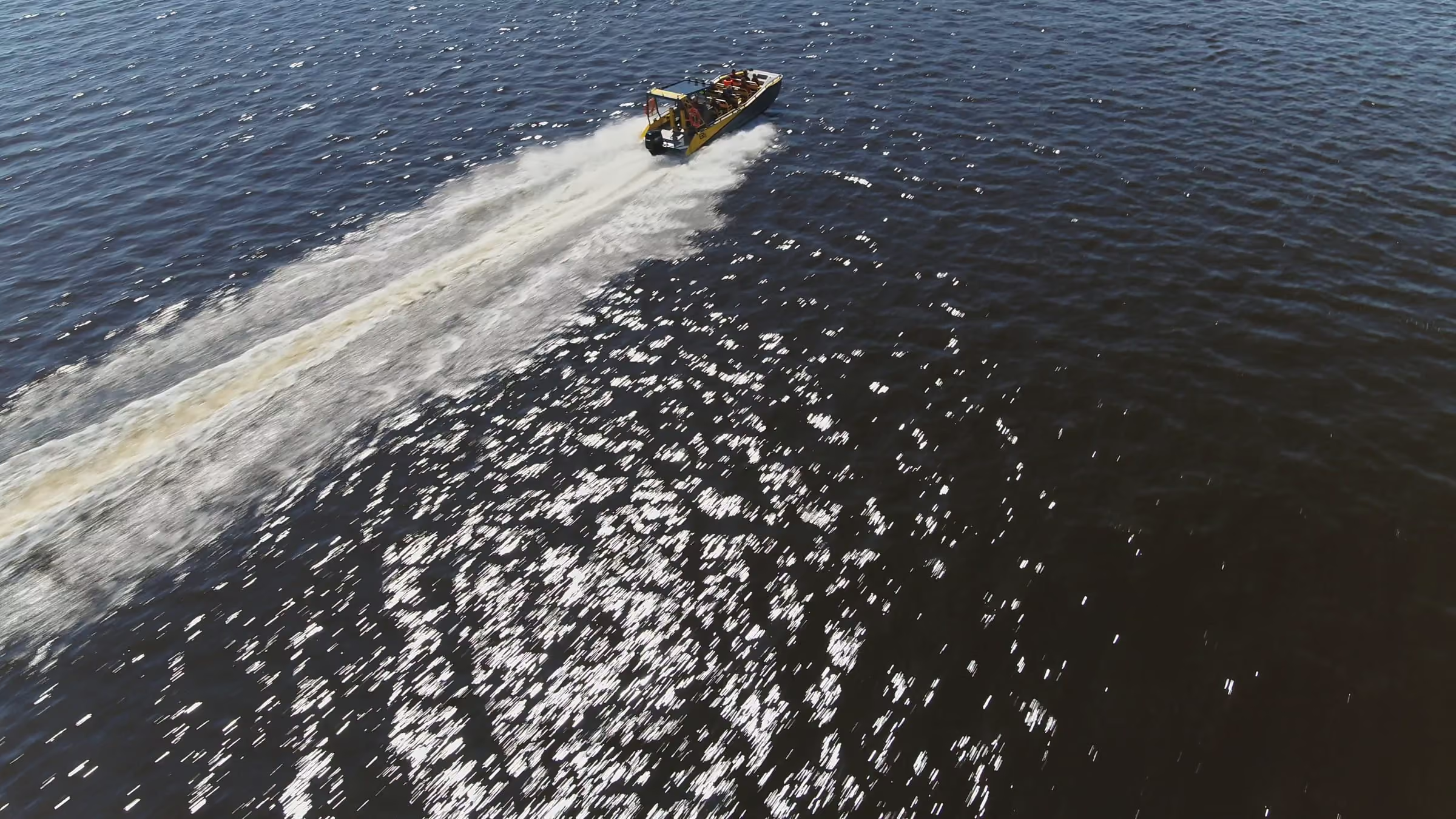
Who does what
You hold the licence.
We supply the evidence.
In every one of these countries the licence is applied for and held by you. No builder can hold it for you. The survey, though, is a survey of our boat, and every question the surveyor asks was settled at the drawing stage. The application is yours. The evidence pack is ours, and when your surveyor asks for a document it exists.
Yours
- The application and the fees
- Operating conditions and the area you work
- The skipper’s ticket and manning
- Insurance
- Booking the periodic survey
Ours
- Stability book, witnessed inclining experiment and GZ curves
- Damage stability calculation
- General arrangement drawing
- Structural drawings and scantling calculations
- Life-saving and escape arrangement drawing
- Engine and equipment certificates
- Material and welding certificates for the alloy
- EU Declaration of Conformity, and the notified body’s file behind it
- Builder’s declaration and owner’s manual
- Answering your surveyor’s questions directly